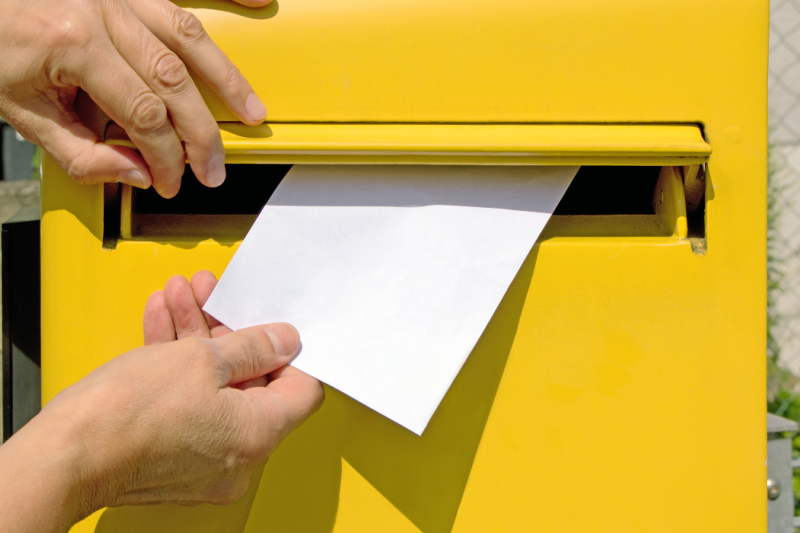
In a recent decision, the Federal Labor Court fundamentally called into question the evidentiary reliability of registered letterbox delivery. We reported on this development. Deutsche Post has since revised its delivery process, meaning that registered letterbox delivery may once again be considered as a method of service. Careful documentation of the delivery process remains crucial.
Starting Point: The Employer Bears the Risk of Receipt
Declarations of intent that must be received by the recipient become effective only upon receipt pursuant to Sec. 130 Para. (1), sentence 1 of the German Civil Code (Bürgerliches Gesetzbuch, BGB). In the employment relationship, this applies in particular to notices of termination, but also to other time-sensitive correspondence. In the event of a dispute, the employer must plead and prove whether and when the specific letter was “received.” Receipt occurs when the letter enters the employee’s sphere of control and, under ordinary circumstances, the employee can be expected to become aware of it. Actual knowledge, by contrast, is not required. The choice and documentation of the method of service are therefore essential elements of legal risk management. Personal handover remains the safest option. In practice, however, this is often not feasible, particularly where the employee is not on site.
For purposes of service, a “registered letterbox delivery” by Deutsche Post had therefore previously been considered a viable option. By contrast, ordinary registered mail or registered mail with return receipt was – and remains – generally unsuitable: if no person authorized to receive the item is present, the item is typically deposited at a post office for collection and is deemed received by the employee only upon collection.
Decision of the Federal Labor Court
In its May 2026 judgment, the Federal Labor Court (Bundesarbeitsgericht, BAG) effectively dealt registered letterbox delivery a serious blow. In its decision (judgment of May 7, 2026, Case No. 2 AZR 184/25), the court held that, following the introduction of the electronic scanning procedure, registered letterbox delivery no longer provides reliable prima facie evidence of actual receipt by the recipient because, under the relevant delivery process, the letter was scanned before being deposited in the mailbox. As a result, there was no subsequent confirmation that the letter had in fact been deposited in the mailbox. We reported on this development.
Deutsche Post Has Revised Its Process: Revival of Registered Letterbox Delivery?
According to a report by Neue Juristische Wochenschrift (NJW), Deutsche Post has revised its delivery process. According to Deutsche Post, as quoted by NJW, it has introduced an additional step into the scanning procedure: after the registered item has been deposited in the mailbox, the delivery person digitally confirms the actual deposit once again and documents it by signing on the scanner.
This should, at least, once again ensure the subsequent confirmation of the actual delivery process required by the BAG. Whether the revised procedure is sufficient to re-establish prima facie evidence of receipt through registered letterbox delivery will likely be clarified by the courts in the near future.
Complete Archiving of All Delivery Documents, Including the Proof of Delivery
Irrespective of the foregoing, legally secure documentation of receipt through registered letterbox delivery remains necessary. What many do not know is that, under the BAG’s case law (judgment of January 30, 2025, Case No. 2 AZR 68/24), the posting receipt and an online tracking record/status, for example in the form of a screenshot, are not sufficient. Rather, evidentiary proof requires submission of the so-called proof of delivery (“Auslieferungsbeleg”).
The proof of delivery is a written record issued by Deutsche Post confirming successful delivery. It states the exact delivery date, the time of delivery, and the delivery person’s signature. It is made available for download free of charge through the individual shipment tracking system and the Post & DHL app - apparently, however, only for 15 months, and therefore for a period significantly shorter than litigation through three instances would typically take. Employers must therefore take action from the outset.
Recommended Standard Process for Registered Letterbox Delivery
It is therefore important to establish a standard process for sending items by registered letterbox delivery, which could be as follows:
Make a complete copy or scan of the signed original before mailing and archive the copy;
Document, using the four-eyes principle, which letter was placed in which envelope; a standardized template is recommended for this purpose;
Record the tracking number on the internal copy;
Place the posting receipt in the case or personnel file;
Promptly review the shipment tracking information to confirm successful delivery;
Immediately download or request the proof of delivery;
What remains clear: Delivery by courier continues to be the safest and most persuasive means of proving receipt. We recommend it in particular for notices of termination and where deadlines are tight, as well as in cases where disputes concerning service by registered mail are anticipated or already exist.
Do you have further questions on this topic?