You are on our german site.

Topics

The EU Pay Transparency Directive in Focus 

Why Should You Act Now

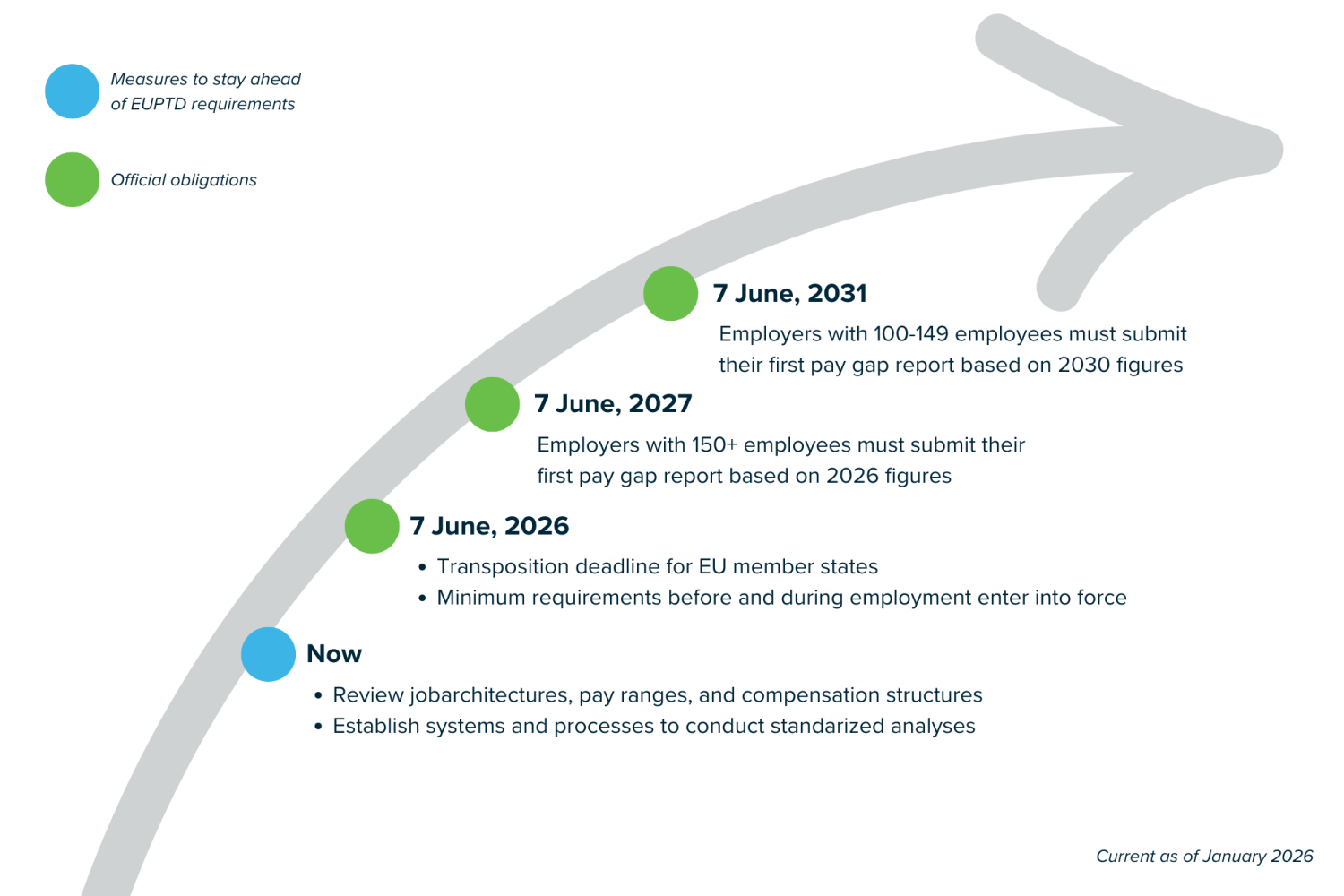
Many companies are currently exempt from reporting obligations under the German Pay Transparency Act, as it applies only to employers with more than 500 employees. However, the EU Pay Transparency Directive, which will come into force on 7 June 2026, will progressively require all private and public organizations with 100 or more employees to promote gender equality in pay. 

Key requirements of the Directive include: 

Transparency prior to employment

Companies must provide applicants with salary ranges for advertised positions and ensure that the recruitment process is gender-neutral and non-discriminatory. Inquiries about applicants' previous salary data are not permitted.

Transparency during employment

Employers are obliged to communicate clear remuneration policies and provide employees with information on their salary and any gender pay gap on request. In addition, open discussions about salary should be made possible without restrictions.

Reporting on the gender pay gap

Companies with 150+ employees must submit regular reports on gender-specific pay gaps and the distribution of remuneration from 2027 and those with 100+ employees from 2031.

Measures in cases of unjustified pay disparities

If there are unjustified wage differences of more than 5%, companies are obliged to carry out an analysis together with employee representatives and take corrective measures.

Legal requirements and sanctions

Companies must provide full compensation for pay inequality and expect sanctions in the event of non-compliance. Employees are also protected from reprisals if they demand their rights.

By implementing these requirements in good time, companies not only comply with legal requirements, but also promote a fairer and more transparent corporate culture.

EU Pay Transparency Tracker

Littler’s EU Pay Transparency Tracker outlines the current legislative status across various EU countries and will monitor ongoing developments as countries implement the Directive’s new obligations. Given the Directive’s tight timeline, this tool helps employers stay informed about their responsibilities.
Learn more

EU Pay Equity and Transparency

The Directive’s requirements intersect with all aspects of an employer’s recruitment and people processes, including remuneration, pay structures, and job frameworks. Attached is a summary of the Directive’s key concepts and obligations, potential penalties, as well as current, country-specific baseline obligations. The summary also provides insights into how to prepare and timing suggestions. You can download the brochure as a PDF here.
EU Pay Equity brochure

FAQ EU Pay Transparency Directive

Practical Answers to Employers' Frequently Asked Questions
FAQ EU Pay Transparency Directive

The Countdown to Implementation Has Begun

To stay ahead of the requirements of the EU Pay Transparency Directive, we recommend taking the following into account when reviewing your internal processes:

Getting Ahead with Pre-Audits: Pay Transparency in Practice

Our experience shows that pre-audits provide a structured entry point into the requirements of the EU Pay Transparency Directive. They help identify initial irregularities, detect data gaps, and develop a clear understanding of where action is needed. 

Through a structured analysis, ranging from the segregation of roles, genders, and compensation data to the review of gender-based pay differences, you can not only gain an initial assessment of your current risk exposure regarding pay transparency but also prepare effectively for future requirements. 

Three reasons to conduct a Pay Equity Pre-Audit: 

  • You gain an overview of which data will be relevant for future reporting obligations and where gaps currently exist.  

  • Noticeable pay disparities become visible and can serve as a starting point for deeper analysis and subsequent measures.  

  • You gain early orientation and can decide, based on this, whether and to what extent further analyses or structural adjustments are required.  

Our approach is based on both the existing German Pay Transparency Act and the upcoming EU Directive. Comprehensive information on our audit methodology can be found here. Take the opportunity to set the course now. 

Strategic Compensation Analysis Made Easy with Littler View

Extensive analyses within larger companies or cross-border projects involving multiple local units can pose significant challenges due to the volume of data. To ensure that you can focus on strategic topics, such as the initial data-driven assessment of pay disparities and the development of concrete measures to eliminate inequalities, we have developed an efficient tool to support your analysis. 

Littler View has been enhanced with an EU Gender Pay Gap Tool, enabling us to establish a starting point for analyzing your compensation structures quickly and at a fixed cost. 

With the Littler View – EU Gender Pay Gap Tool, we can:

  • Provide an efficient starting point for analyzing your compensation data. Data provided by you in Excel format can be assessed at the push of a button.  

  • Identify risk factors. Salaries showing irregularities are automatically “red-flagged” and highlighted for further detailed review.  

  • Visualize results. Aggregated data is displayed in interactive dashboards, providing a solid foundation for further analysis.  

Your Benefits at a Glance

  • Quick entry into initial data analysis with first results available in a short timeframe  

  • Up-to-date data basis derived from the data you provide  

  • Comparison with historical data to track the development of pay gaps  

  • In the early stages of analysis, depending on the specific setup, it may be possible to proceed without the immediate involvement of employee representatives 

Your expertteam